Tuesday, September 18, 2012

Interviewing

An interview is when an interviewer asks someone questions in order to gain information. Journalistic interviews are different from regular ones. One reason, is that you need to write things down, and you don't always have a specific purpose. The interview must be formed into something that people will read.
Before an interview, you must find a good place to interview people. You need to reasearch the topics you will be talking about. Practice makes perfect for interview questions. You also have to figure out some questions before hand. During the interview, try to be polite, respectful, and honest, Ask good, open questions that are out of the ordinary. Try to make the interview feel like a typical conversation. Let them talk about the things they like, and ask their own questions. Afterwards, review everything to make sure you have the information you need. Make important things and less important things so it will be easy to put the inverted pyramid format.
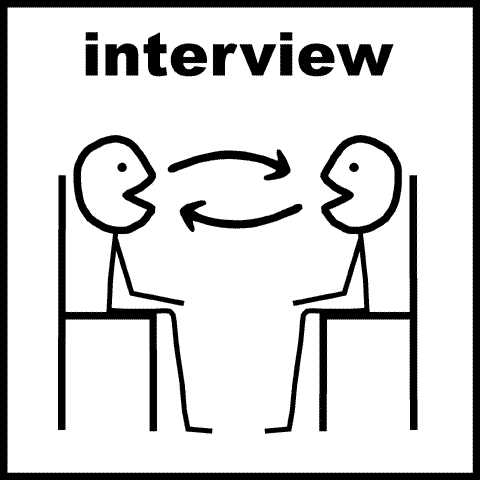
Putting information from an interview into an article isn't too hard. You can write it in script format, telling what you said and the interviewee said. You can look in books with interviews and copy how they do it. Everyone should know the stuff in this post because it is very basic. What do you think? That we could have gotten all technical? We only had under an hour! So, tell everybody that this site has awesome interviewing tips!

References:
1. "13 Simple Journalist Techniques for Effective Interviews." Matador Network. N.p., n.d. Web. 17 Sept. 2012. http://matadornetwork.com/bnt/13-simple-journalist-techniques-for-effective-interviews/.
2. "30 Tips on How to Interview Like a Journalist." 30 Tips on How to Interview Like a Journalist. N.p., n.d. Web. 17 Sept. 2012. http://www.sparkminute.com/2011/11/07/30-tips-on-how-to-interview-like-a-journalist/.
3. "The Bulldog Bulletin Introduction to Journalism." The Bulldog Bulletin Introduction to Journalism. N.p., n.d. Web. 17 Sept. 2012. http://www.tmsjournalism.blogspot.com/.

Thursday, September 13, 2012

Media Release

A media release, or press release, is a written or recorded brief summary or update item given to the media to broadcast. We often use press release for advertising or promotions for our businesses. Also, if there was a very important news, you could send tell the media to annouce it.

An example of media release would be if there was an annual spelling bee at the county fair and the winner will advance to the state final to compete. After they crowned the spelling bee, they could tell the journalist to write about the spelling bee and who advanced to the finals. Then the journalist can print it and then more people will know about you!

The media release will help this class because we can print news and everyone will know about the news. Also, this will help me to interview different people to get news to publish. We can get new stories from teachers, staff, students, parents, and more. We always want to have new stories to write about!

References: The Bulldog Bulletin Introduction, http://www.tmsjournalism.blogspot.com/2012/09/media-release.html, 9/12/12
Wikipedia, Press Release, http://en.wikipedia.org/wiki/Press_release, 9/12/12
Introduction To Journalism, John Reque, pg. 83, 9/13/12

Monday, September 10, 2012

Inverted Pyramid Structure

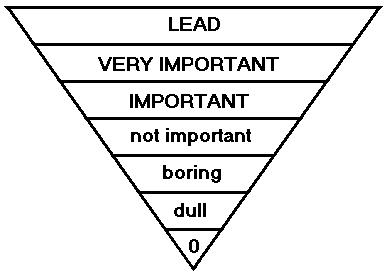
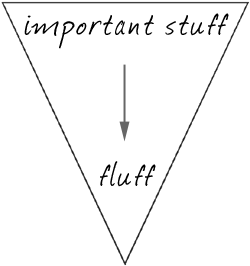
 The inverted pyramid is a method for writing stories and is important to journalism students. The inverted pyramid helps the journalist attract more readers.  At the top, you would write about the main idea, climax, and the primary elements.  On the next part, you write about the supporting details. On the last part, it should tell information like the specific details, but it is not required.

A journailist will use the inverted pyramid to make their writing easier to understand. For example, there was a very close football game.  On the top of the pyramid, you would say that they made the last touchdown in the last 30 seconds. Then, you could say which team was leading, who played well, and why it came very close. It works because people will be able to know the crucial stuff on the top of the pyramid. As the reader continues to read, the reader can stop anytime, but still get the climax.


This inverted pyramid helps the class to attract more readers and know what information is imporant and which ones are not necessary. It also helps us to be more structured and orginized. I will use this in my future wok and hope to write the imortant idea and work down to the good supporting details.


References:
Inverted pyramid, Wikipedia, http://en.wikipedia.org/wiki/Inverted_pyramid 9/7/12
Using the Inverted Pyramid to Write articles, Yahoo voices, http://voices.yahoo.com/using-inverted-pyramid-write-news-articles-212793.html?cat=4, 9/7/12
The Complete Idiot's Guide to Journallism, Christopher K. Passante, 9/10/12

Thursday, September 6, 2012

Bias

What is bias in journalism? Bias is not stating the facts and, instead telling your opinion.  In journalism, it is important not to be bias because bias could cause a misunderstanding between our opinions and the news. Then, people will think that your opinions are the facts. However, it is acceptable to state your opinions on the opinion page, but not on the news.

Journalism with bias is not teling the facts and putting your own opinions into the article. Also, you don't want to be sterotype. For example, a person got hurt and the detectors had no evidence that the murderer used a weapon. In the article, the journalist is against him and say that he is guilty and should be in jail. It is being bias because you only state that the murderer is guilty and bad. Instead, tell the people that the police didn't find any evidence that the murderer had used a weapon because it is important!

It is important for kids in the journalism class to understand about bias because they will be able to write new without being bias. In the future, I will know not to put my opinions in my news. Also, when I proof read my classmate's writing, I will be able to correct any errors if they are being bias. You should aways tell both sides of the story and not just one side that you want.  DON'T BE BIASED!

Wikipedia Media Bias, http://en.wikipedia.org/wiki/Media_bias, 9/4/12
Book: Christopher K. Passante, The Complete Idiot's Guide To Journailsm, pg. 28, 9/5/12

Thursday, August 30, 2012

Journalistic Integrity

Journalistic integrity is a about being fair and honest. Not being bias and being truthful. Doing what is right and fair, not wrong. The key elements of journalistic integrity is accuracy, avoiding bias, distortions, gathering information, and minimizing harm. Accuracy is when mistakes, or error occurs, from the information and must be corrected quickly. Avoiding bias is very important because you are being fair. However, you can state your opinion, but you can't let it affect your writing. 
 A journalist without integrity is when they are bias and they lie about the facts. For example, if there was a court case about someone stealing at target, and the journalist told the wrong facts, the journalist doesn't have integrity. Instead, the journalist can tell the truth. A journalism may tell rumors about celebritys and lie about politics, but they don't have much integrity.
Journalistic integrity is important to the class because it teaches the students to tell the truth, not cause conflicts, and be yourself. For example, when I write, I will not make assumptions, tell lies, and give false information. You want to know the truth and we need to tell the facts, not being bias. People want the facts and a journalist will have integrity and write the truth!


Reference: Purdue OWL,http://owl.english.purdue.edu/owl/resource/735/03/, 8/28/12
Wikipedia: Journalism ethics and standards,
 http://en.wikipedia.org/wiki/Journalism_ethics_and_standards, 8/28/12
Taylor Middle School: The Bulldog Bulletin Introduction To Journalism, http://www.tmsjournalism.blogspot.com/, 8/27/12
Book:John Reque, Introduction To Journalism, Page:23