Thursday, October 25, 2012

Taylor Students Bring Baggage

Recently at Taylor Middle School, there has been an issue about how much supplies students bring to class because there has been a problem. A majority of teachers at Taylor believe that students having backpacks in the classroom is a problem. However, students at Taylor think that students should be allowed to bring they're backpacks to class.
Many teachers say that students should only bring materials for two periods at a time. The result of students having their backpacks in class can cause tripping hazards, having early disengagement from activity, cause back problems, distractions from class, and more. Some students at Taylor disagree with the idea of no backpacks in class. Teachers say that kids don't need to bring so much supplies since the students have lockers. Most students at Taylor don't agree with the teachers. A 7th grade girl with a backpack said, "I think that students should be able to bring our backpacks to class. I don't that backpacks are a distraction becuase you don't play with it a lot during class. Also, putting your backpack under your table will decrese the percent of people tripping over your backpack, causing injuries. The reason to have a backpack is to be able to put your materials you need for the period. Backpacks were made so you don't need to carry everything around campus. Also, your locker may be too far, so you don't have enough time in passing period to go to your locker and go to your next period. Espicially when you need a bathroom break!"
There has been other schools that has banned school from backpacks and handbags. A Middle/ High School in New York called Lake Placid is banning students from bringing backpacks and handbags to school. They're afraid that students may sneak  illegal and dangerous items onto school grounds. What do you think about the policy?

Monday, October 15, 2012

Taylor Pledges To Stop Bullying

Taylor Pledges To Stop Bullying   


MILLBRAE, California- Taylor Middle School encourages students to pledge to stop bullying. On Monday, October 1, 2012, Taylor students all learned how to not be bystanders, to stop bullying, and help each other. Students at Taylor all have different opinions about bullying and cyberbullying. One student from Taylor said, "I think bullying is mean, offensive, and depressing. Bullying shouldn't be allowed and must be stopped. The victim should tell an adult to stop what is happening." Another student said, " Bullying is bad and it can really hurt someone's feelings." Bullying can be harmful in many ways. It could lead to depression, anxiety, or serious death. Students said, "Bullying is damaging and it could affect the person. The person may commit suicide and do other horrible things that could harm themselves."
Victims and bystanders are a huge part of bullying. One of the students I interviewed at Taylor that was a victim said, "In 3rd grade, I was a victim and I would always be bullied. The bully would make fun of me and I felt scared. I didn't say anything because I was afraid they would hurt me." Being a bystander is being a big part in the situation. A bystander at Taylor said, "I was a bystander in one situation and I watched what the bully did to the victim. The bully was trash talking to the victim. I didn't stand up for the victim because I thought that the bully was going to bully me too. Thankfully, a few minutes later, the bully went away. However, in the future, I plan to make a difference and stop the bullying instead of being a bystander." Instead of being bystanders, they can make a move and  can stop bullies from bullying. Don't stand by, stand up!

By: Rachel

Friday, September 28, 2012

Taylor Middle School Inspires Great Leadership

Taylor Middle School Inspires Great Leadership


Mr. Sullivan (Leadership Teacher)
 MILLBRAE, California- Taylor Middle School in its 74th year is continuing a 20 year tradition of creating great leaders. The leadership program is to train students to become great leaders not only in the school, but also in our community. The program teaches students to design, plan, and advertise school wide events. In addition, the program instructs the students to be responsible, to work together and to build strong friendships with everyone.

The leadership curriculum is for students to support the school, environment, and neighborhood. The program consists of four different committees. They are the public relations, the beautification, the events, and the fundraising. In public relations, the students learn to interact with different people in the community and in the school. The beautification committee makes the school a clean, pleasant, place to learn. The event committee is in charge of planning and designing dances and other events. Lastly, the fundrasing committee raises money for the dances and other school wide activites.
The leadership program is for the community and the students at Taylor. They support the school by holding fundraisers, dances, school lunch activites, and more. Some students from leadership students said, "We help the students in this school by socializing with different students, preparing events, and making the school a cleaner enviornment." The program benefits the community by doing at least 30 hours of community service a year.

The leadership's plans for this year include learning about a great leader, digital media and communication, and working together. They will also complete a study project using collective documents to learn about a good leader in the world. Also, the students will preform 4 different types of speeches. The different speeches are informative, demonstrative, persuasive, and entertaining. In addition, the kids do face to face meetings as well as through emails, edmodo, and other websites. During the meetings, they discuss about the future situations and more.

Students at Taylor chose leadership because they wanted to design, create, and plan school wide activities. They want to help the school to make it a better place by holding fun fundraisers, dances, and lunch time activities. A student from leadership said, "My goal is to make all the students have a lot of spirit for the school." Leadership program trains young students to become a great leader in the future.  

Tuesday, September 18, 2012

Interviewing

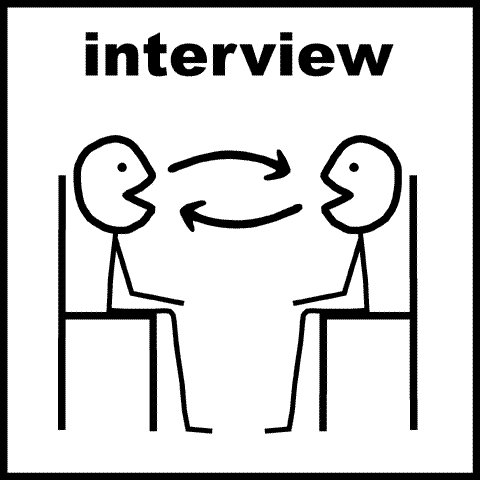
An interview is when an interviewer asks someone questions in order to gain information. Journalistic interviews are different from regular ones. One reason, is that you need to write things down, and you don't always have a specific purpose. The interview must be formed into something that people will read.
Before an interview, you must find a good place to interview people. You need to reasearch the topics you will be talking about. Practice makes perfect for interview questions. You also have to figure out some questions before hand. During the interview, try to be polite, respectful, and honest, Ask good, open questions that are out of the ordinary. Try to make the interview feel like a typical conversation. Let them talk about the things they like, and ask their own questions. Afterwards, review everything to make sure you have the information you need. Make important things and less important things so it will be easy to put the inverted pyramid format.

Putting information from an interview into an article isn't too hard. You can write it in script format, telling what you said and the interviewee said. You can look in books with interviews and copy how they do it. Everyone should know the stuff in this post because it is very basic. What do you think? That we could have gotten all technical? We only had under an hour! So, tell everybody that this site has awesome interviewing tips!

References:
1. "13 Simple Journalist Techniques for Effective Interviews." Matador Network. N.p., n.d. Web. 17 Sept. 2012. http://matadornetwork.com/bnt/13-simple-journalist-techniques-for-effective-interviews/.
2. "30 Tips on How to Interview Like a Journalist." 30 Tips on How to Interview Like a Journalist. N.p., n.d. Web. 17 Sept. 2012. http://www.sparkminute.com/2011/11/07/30-tips-on-how-to-interview-like-a-journalist/.
3. "The Bulldog Bulletin Introduction to Journalism." The Bulldog Bulletin Introduction to Journalism. N.p., n.d. Web. 17 Sept. 2012. http://www.tmsjournalism.blogspot.com/.

Thursday, September 13, 2012

Media Release

A media release, or press release, is a written or recorded brief summary or update item given to the media to broadcast. We often use press release for advertising or promotions for our businesses. Also, if there was a very important news, you could send tell the media to annouce it.

An example of media release would be if there was an annual spelling bee at the county fair and the winner will advance to the state final to compete. After they crowned the spelling bee, they could tell the journalist to write about the spelling bee and who advanced to the finals. Then the journalist can print it and then more people will know about you!

The media release will help this class because we can print news and everyone will know about the news. Also, this will help me to interview different people to get news to publish. We can get new stories from teachers, staff, students, parents, and more. We always want to have new stories to write about!

References: The Bulldog Bulletin Introduction, http://www.tmsjournalism.blogspot.com/2012/09/media-release.html, 9/12/12
Wikipedia, Press Release, http://en.wikipedia.org/wiki/Press_release, 9/12/12
Introduction To Journalism, John Reque, pg. 83, 9/13/12

Monday, September 10, 2012

Inverted Pyramid Structure

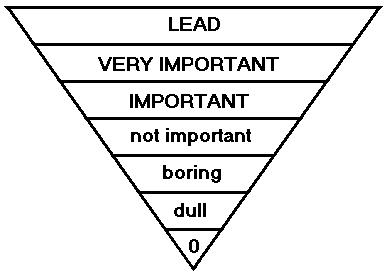
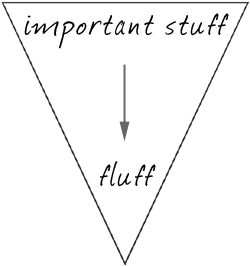
 The inverted pyramid is a method for writing stories and is important to journalism students. The inverted pyramid helps the journalist attract more readers.  At the top, you would write about the main idea, climax, and the primary elements.  On the next part, you write about the supporting details. On the last part, it should tell information like the specific details, but it is not required.

A journailist will use the inverted pyramid to make their writing easier to understand. For example, there was a very close football game.  On the top of the pyramid, you would say that they made the last touchdown in the last 30 seconds. Then, you could say which team was leading, who played well, and why it came very close. It works because people will be able to know the crucial stuff on the top of the pyramid. As the reader continues to read, the reader can stop anytime, but still get the climax.


This inverted pyramid helps the class to attract more readers and know what information is imporant and which ones are not necessary. It also helps us to be more structured and orginized. I will use this in my future wok and hope to write the imortant idea and work down to the good supporting details.


References:
Inverted pyramid, Wikipedia, http://en.wikipedia.org/wiki/Inverted_pyramid 9/7/12
Using the Inverted Pyramid to Write articles, Yahoo voices, http://voices.yahoo.com/using-inverted-pyramid-write-news-articles-212793.html?cat=4, 9/7/12
The Complete Idiot's Guide to Journallism, Christopher K. Passante, 9/10/12

Thursday, September 6, 2012

Bias

What is bias in journalism? Bias is not stating the facts and, instead telling your opinion.  In journalism, it is important not to be bias because bias could cause a misunderstanding between our opinions and the news. Then, people will think that your opinions are the facts. However, it is acceptable to state your opinions on the opinion page, but not on the news.

Journalism with bias is not teling the facts and putting your own opinions into the article. Also, you don't want to be sterotype. For example, a person got hurt and the detectors had no evidence that the murderer used a weapon. In the article, the journalist is against him and say that he is guilty and should be in jail. It is being bias because you only state that the murderer is guilty and bad. Instead, tell the people that the police didn't find any evidence that the murderer had used a weapon because it is important!

It is important for kids in the journalism class to understand about bias because they will be able to write new without being bias. In the future, I will know not to put my opinions in my news. Also, when I proof read my classmate's writing, I will be able to correct any errors if they are being bias. You should aways tell both sides of the story and not just one side that you want.  DON'T BE BIASED!

Wikipedia Media Bias, http://en.wikipedia.org/wiki/Media_bias, 9/4/12
Book: Christopher K. Passante, The Complete Idiot's Guide To Journailsm, pg. 28, 9/5/12